![Multi Restaurant Aggregator [MRP]](https://eatanceapp.com/wp-content/uploads/2022/03/Hamburger.svg)



Food ordering is already digital, but that does not always mean it is fast.
Customers may know exactly what they want, yet still spend time searching restaurants, scrolling through menus, applying filters, comparing options, and customizing items before they can place an order.
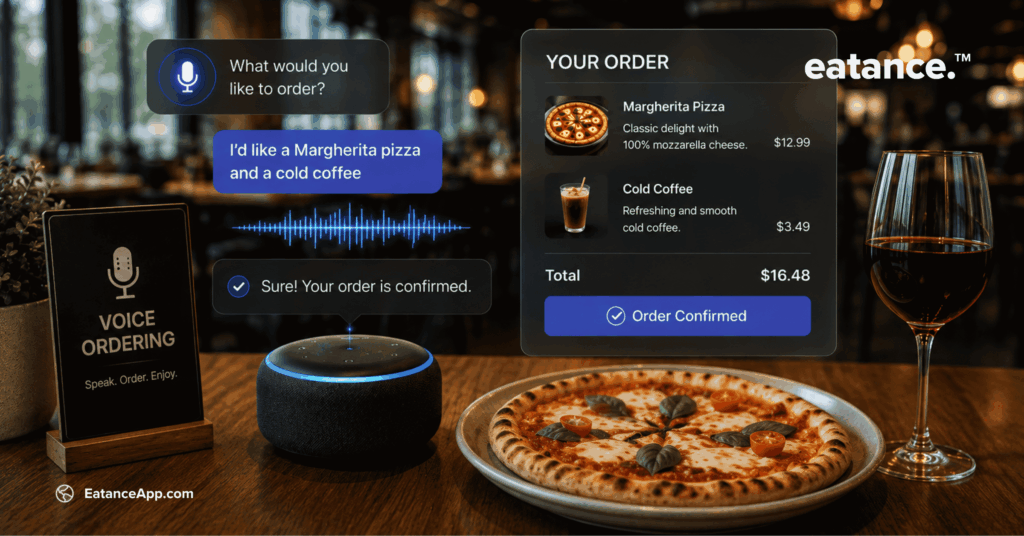
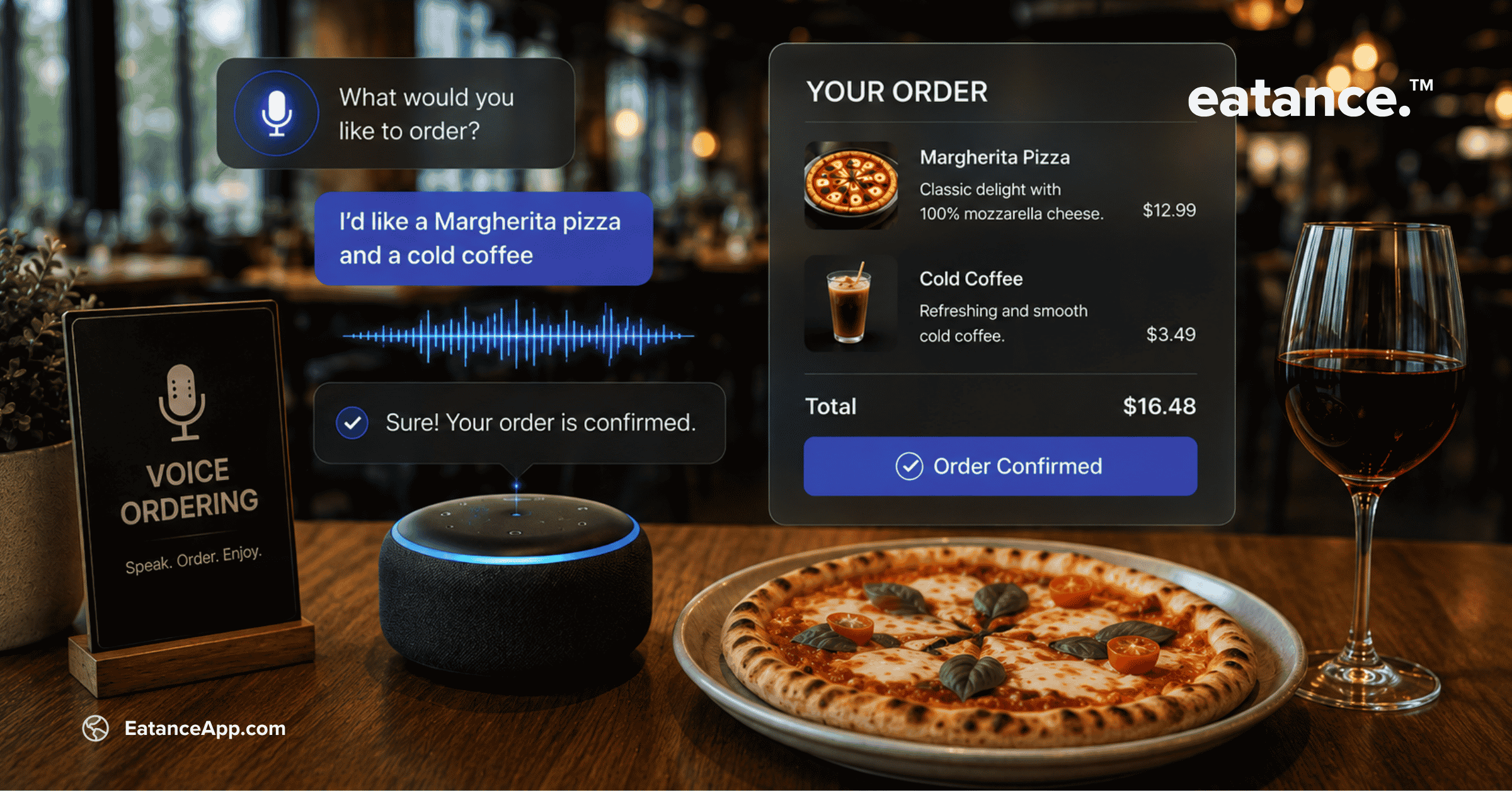
Voice ordering for restaurants changes that by letting customers simply say what they want.
“Find me a spicy vegetarian meal under $15.”
“Show me a high-protein vegetarian dinner.”
“Add two pizzas, fries, and three drinks.”
With AI voice ordering, the system can understand the request, identify preferences, match them with relevant menu options, and help customers reach the right order with fewer steps.
In this blog, we explore how voice ordering works, where AI adds intelligence to the process, how it can reduce ordering friction, and how platforms like Eatance MRP 3.0 are bringing these capabilities into multi-restaurant food delivery experiences.
What Is AI Voice Ordering for Restaurants?
AI voice ordering allows customers to interact with a restaurant or food delivery platform using natural spoken language.
Instead of typing keywords, opening menu categories, or applying filters one by one, the customer can simply describe what they want.
For example, there is an important difference between:
Traditional search:
“Burger”
and
AI voice request:
“Find me a spicy burger under $15.”
The second request gives the system much more context. It tells the platform:
- The customer wants a burger.
- The customer wants something spicy.
- The preferred budget is below $15.
A capable voice ordering system can process these requirements together instead of forcing the customer to enter them separately.
Quick Stat:
According to the National Restaurant Association, 45% of delivery customers said they would use a voice-enabled platform such as Siri, Alexa, or Google Home to order food if the option were availabl.
That is what makes modern voice ordering different from basic voice commands. The goal is not just to recognize spoken words. It is to understand food-related intent and connect it with actual restaurant and menu information.
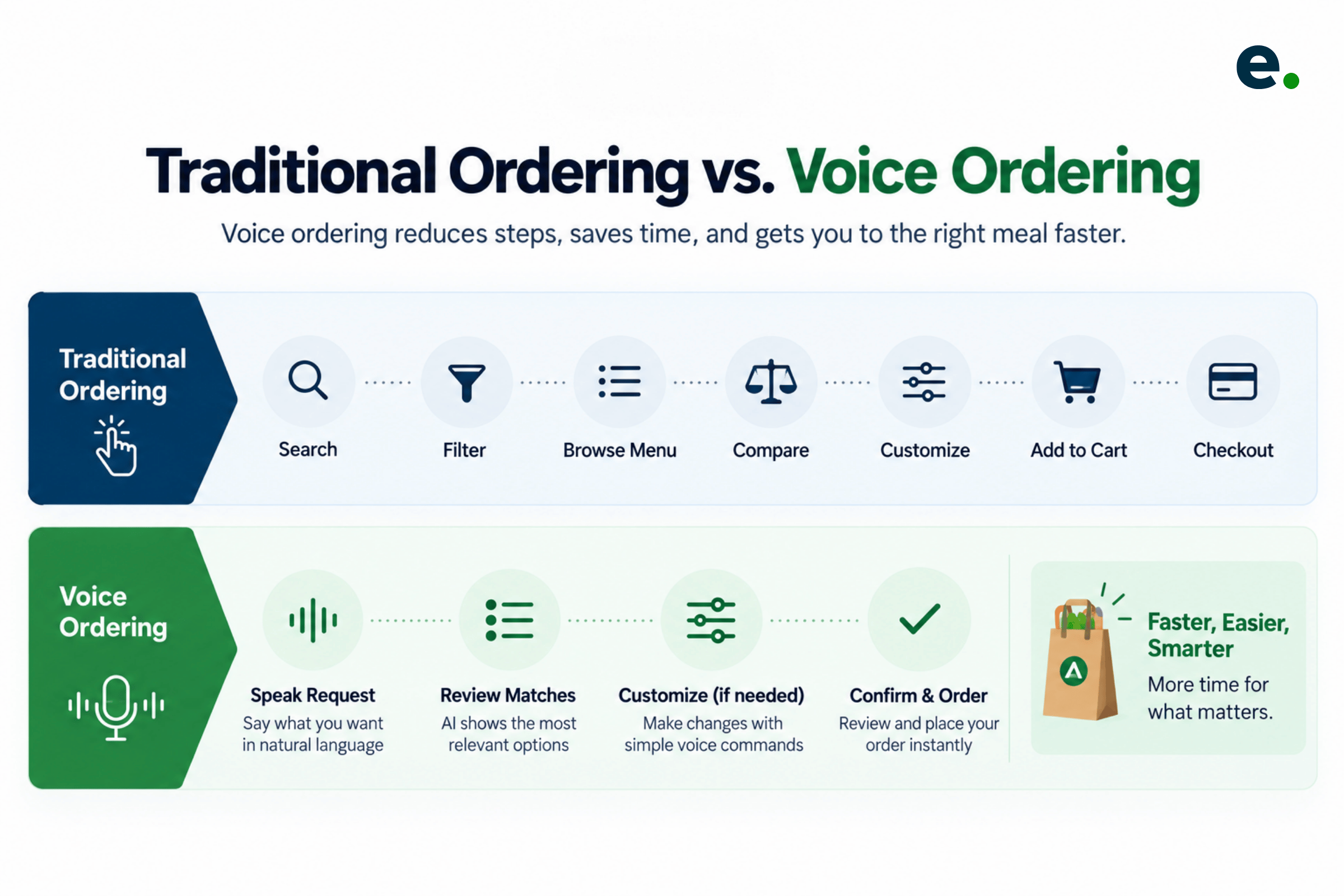
Traditional Ordering vs Voice Ordering in Restaurants
Why Traditional Food Ordering Can Still Feel Slow
Online ordering has made food delivery far more convenient, but finding the right meal can still take time, especially when customers have hundreds of restaurants and menu items to choose from.
A customer may already know what they want, but turning that intent into an actual order often involves several steps:
- Finding the right restaurant: Customers may know they want biryani, vegan pasta, or a high-protein meal without knowing which restaurant offers the right option.
- Browsing long menus: Large menus with categories, combos, sides, drinks, and add-ons can make discovery slower.
- Applying multiple preferences: Price, cuisine, dietary needs, ingredients, ratings, and delivery time may require separate searches or filters.
- Customizing the order: Size, toppings, sauces, quantities, and special preferences can add even more interactions before checkout.
- Typing detailed requests: On mobile devices, entering specific requirements can feel cumbersome, particularly when customers are multitasking or ordering quickly.
The challenge becomes even greater on a multi-restaurant platform, where customers are not navigating one menu but potentially hundreds of options across different restaurants.
This is where voice-enabled food ordering can simplify the journey. Instead of translating their needs into keywords, categories, and filters, customers can describe what they want naturally and let the system interpret their intent.
How Does AI Voice Ordering Work?
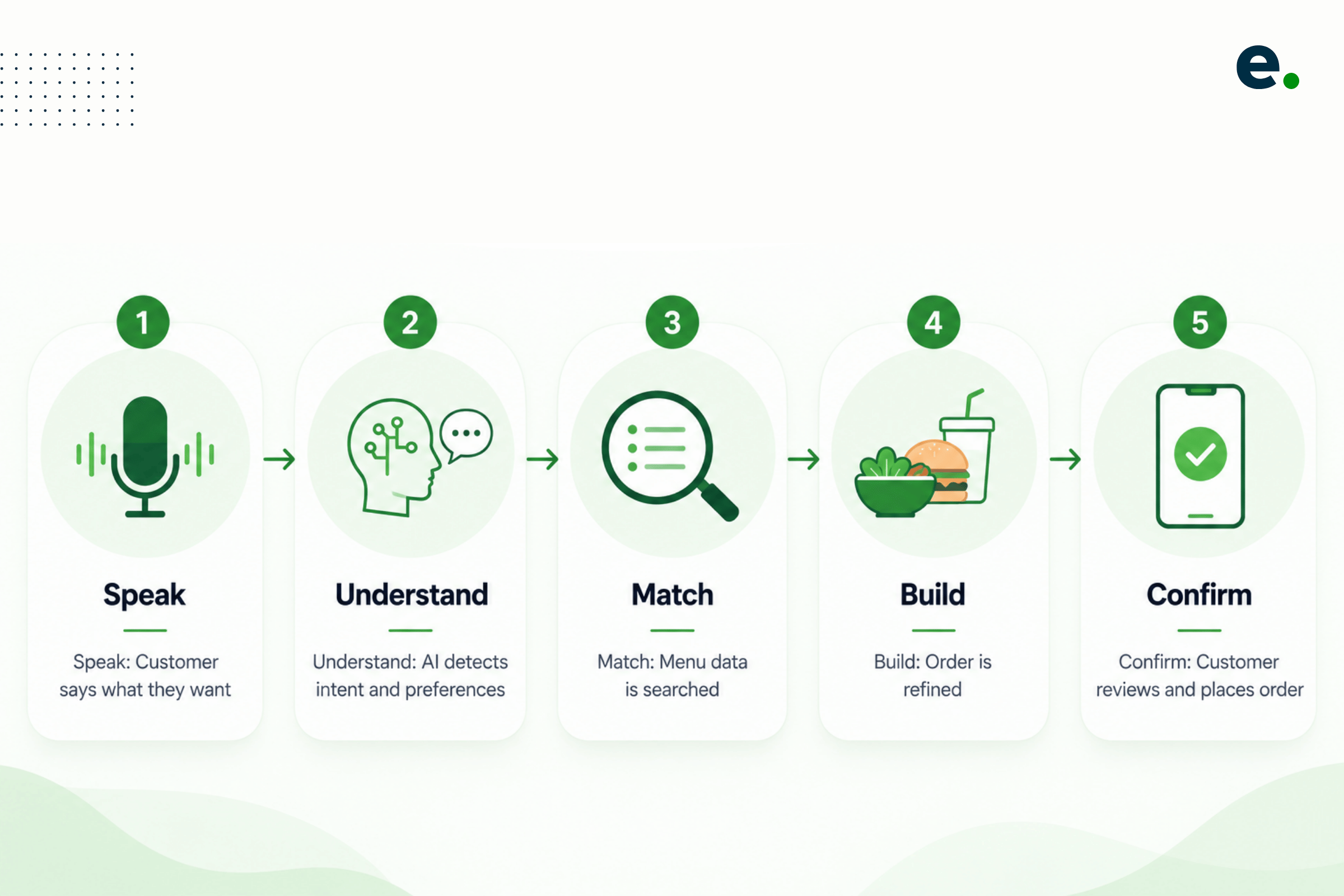
How AI Voice Ordering Works in Restaurants
AI voice ordering turns a spoken request into something the restaurant platform can understand and act on. The customer simply says what they want, while the system handles the interpretation, menu matching, and order building in the background.
Voice ordering can also support follow-up requests without starting over. For example, after selecting a dish, a customer might say:
“Make that large.” → “Remove the onions.” → “Show me a cheaper option.”
A restaurant voice assistant uses the context of the conversation to understand what each follow-up request refers to and adjust the order accordingly.
In simple terms, AI voice ordering connects spoken intent with menu data and ordering logic, helping customers move from request to order with fewer manual steps.
Revmo’s voice AI ordering system allows us to provide a more convenient and consistent experience for our guests.” This reflects the broader shift toward making voice interaction part of the ordering experience rather than treating it as a separate feature.
- Kevin King, CEO and President of Donatos Pizza
From Taps to Conversation: How Voice Changes the Ordering Journey
Traditional restaurant apps are mostly built around navigation.
A typical journey may look like:
Open App → Search → Filter → Select Restaurant → Browse Menu → Choose Dish → Customize → Add to Cart
Voice introduces a different starting point:
Express Intent → Review Matches → Customize → Confirm
This does not mean customers will stop browsing visual menus.
They may still want to compare images, read descriptions, check nutritional information, view ratings, or manually adjust their cart.
The difference is that voice can reduce unnecessary navigation.
Instead of requiring the customer to understand how the app is organized, the platform can start by understanding what the customer wants.
What Can Customers Ask a Voice Ordering System?
The practical value of voice ordering becomes much clearer through real examples.
Use Case 1: Finding a Specific Dish
“Find veggie biryani near me.”
This works much like conventional search but removes the need to type.
Use Case 2: Ordering Based on a Craving
“I want something spicy and cheesy.”
Here, the customer has not decided on an exact dish. The system needs to interpret the craving.
Use Case 3: Adding Dietary Preferences
“Show me vegetarian meals with high protein.”
The customer can combine more than one preference in the same request.
Use Case 4: Setting a Budget
“Find dinner for two under $30.”
Price becomes part of the food discovery process.
Use Case 5: Customizing an Item
“Make that large, remove onions, and add extra cheese.”
Voice can make modifiers feel more natural when the system understands the restaurant's available options.
Use Case 6: Building a Multi-Item Order
“Add two veggie burgers, one large fries, and three drinks.”
This can be faster than adding every item individually.
These examples show why voice ordering should not be treated as simply a voice version of a search box.
Why AI Makes Voice Ordering Smarter Than Basic Speech Recognition
Speech recognition can tell a system what a customer said. AI helps it understand what the customer actually wants.
That difference is important in restaurant ordering because customers rarely speak in perfectly structured menu terms. They describe cravings, preferences, budgets, ingredients, and follow-up changes in natural language.
For a useful AI voice ordering experience, several capabilities need to work together:
- Speech recognition: Captures the customer’s spoken words accurately.
- Intent understanding: Identifies what the customer is trying to do, such as search for a dish, add an item, remove an ingredient, or compare options.
- Menu intelligence: Connects everyday customer language with actual dishes, categories, ingredients, and modifiers available on the menu.
- Conversational context: Remembers what has already been discussed so customers can make follow-up requests without repeating everything.
- Recommendation intelligence: Helps narrow available choices based on factors such as cravings, dietary preferences, price, or other relevant signals.
Quick Stat:
Nearly 80% of regular U.S. diners believe AI voice assistants will handle most food ordering within the next few years, according to a SoundHound consumer study.
For example, a customer might begin with:
“Show me veggie wraps.”
Then continue with:
“Only spicy ones.”
And finally ask:
“Which one is cheaper?”
A basic speech recognition system can capture each sentence. An AI-powered system goes further by understanding that “spicy ones” refers to the veggie wraps already shown and that the final question asks for a price comparison within those same options.
Similarly, a restaurant may list a dish under a branded name that a customer has never heard before. If someone simply asks for a “vegetarian burger,” menu intelligence can help connect that everyday description with relevant items on the restaurant’s menu.
This ability to understand intent, context, and menu relationships is what makes an AI-powered voice ordering system more useful than basic speech-to-text technology.
Where Can Voice Ordering Be Used?
Voice ordering is not limited to one type of restaurant interaction. It can be used across different digital and physical ordering touchpoints, depending on how customers engage with the business.
Quick Stat:
According to Deloitte, 79% of consumers surveyed said they were at least somewhat likely to return to a restaurant using automated voice ordering at the drive-thru, while 74% said the same for phone ordering and 70% for dine-in voice systems.
Some of the most relevant use cases include:
- Food delivery apps: Customers can search for dishes, express preferences, and build orders by speaking instead of navigating multiple menus and filters. This can be especially useful in a multi restaurant app, where the number of available options is much larger.
According to the National Restaurant Association, 45% of delivery customers said they would use a voice-enabled platform for ordering, rising to 58% among millennials.
- Restaurant websites: Voice can work alongside traditional search and menu navigation, giving customers another way to find dishes and communicate preferences.
- Phone ordering: An AI voice assistant can handle incoming calls, understand customer requests, and help capture orders without requiring staff to manage every call manually.
Quick Stat:
SoundHound’s restaurant phone-ordering technology has processed more than 100 million customer interactions, including hundreds of millions of dollars’ worth of food orders.
- Drive-thru ordering: Restaurants can use voice AI to interpret spoken orders in high-volume drive-thru environments and pass them into the ordering workflow.
- Self-service kiosks: Voice can complement touchscreen ordering, allowing customers to speak requests or modifiers rather than navigating every option manually.
- Connected ordering experiences: Voice can also support situations where using a screen is less convenient, such as certain in-car or hands-free interactions.
The role of voice will vary across these environments. For a single restaurant, it may primarily help capture or customize an order. On a multi-restaurant platform, it can play a broader role by helping customers discover relevant options across multiple menus before they even decide where to order.
For Eatance, this second use case is especially relevant because voice interaction can become part of the customer’s digital discovery and ordering journey within the platform.
Why Voice Ordering Can Make Food Ordering Faster
The biggest advantage of voice ordering is not that customers speak instead of tap. It is that one spoken request can replace several small actions in the ordering journey.
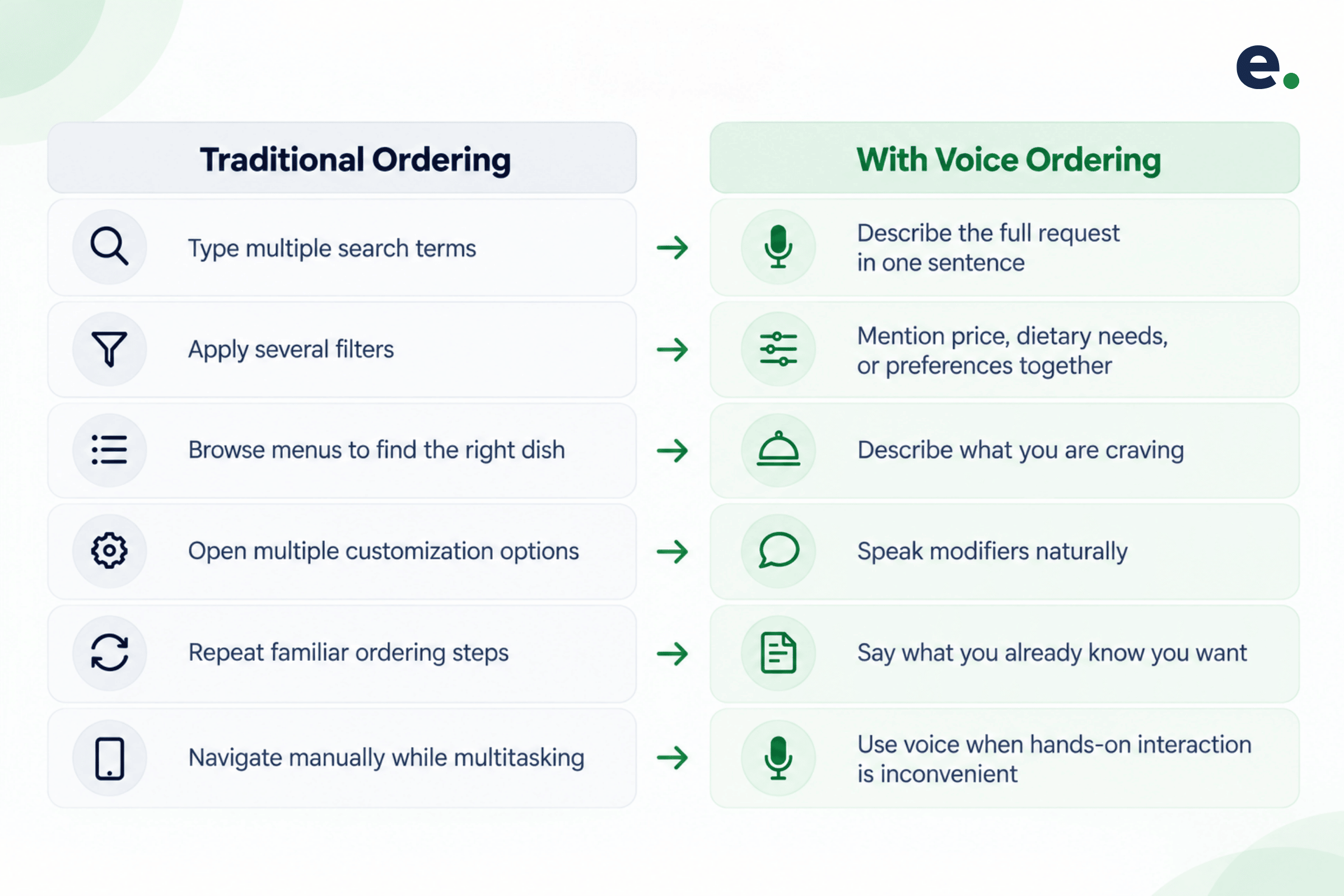
Traditional Food Ordering vs Voice Ordering
For example, instead of searching for “pasta,” applying a vegetarian filter, setting a price range, and then browsing several options, a customer could simply say:
“Show me vegetarian pasta under $20.”
That single request combines the dish, dietary preference, and budget into one interaction.
Voice can also make customization more direct. Rather than opening separate controls for size, toppings, or exclusions, customers may be able to say things like:
- “Make that large.”
- “Add extra cheese.”
- “Remove the onions.”
- “Show me a cheaper option.”
This does not mean voice should replace the traditional app interface. A more practical experience is often a combination of both. Customers can start with voice, review the suggested options visually, make any manual changes they want, and complete checkout through the normal flow.
In that sense, voice ordering for restaurants is less about removing screens and more about reducing the number of steps customers need to take before reaching the right order.
Why Voice Ordering Matters More on Multi-Restaurant Platforms
Voice ordering becomes particularly valuable when customers have a large number of choices.
A single restaurant may have dozens of items. A large multi restaurant app may include hundreds or thousands of dishes across different restaurants.
Consider this request:
“Find me a vegetarian pasta under $18 that would be good for dinner.”
Without intelligent assistance, the customer may need to:
- Search for pasta.
- Open several restaurants.
- Compare prices.
- Check vegetarian options.
- Review individual menus.
- Select a suitable dish.
A voice-enabled system can potentially interpret several of those requirements at once and narrow the available choices earlier.
That is why voice has a different value on a multi restaurant online ordering system.
It does not simply save typing. It can help customers manage choice.
Voice Ordering vs. Traditional App Ordering
Traditional app ordering and voice ordering are not mutually exclusive. In many cases, they work better together.
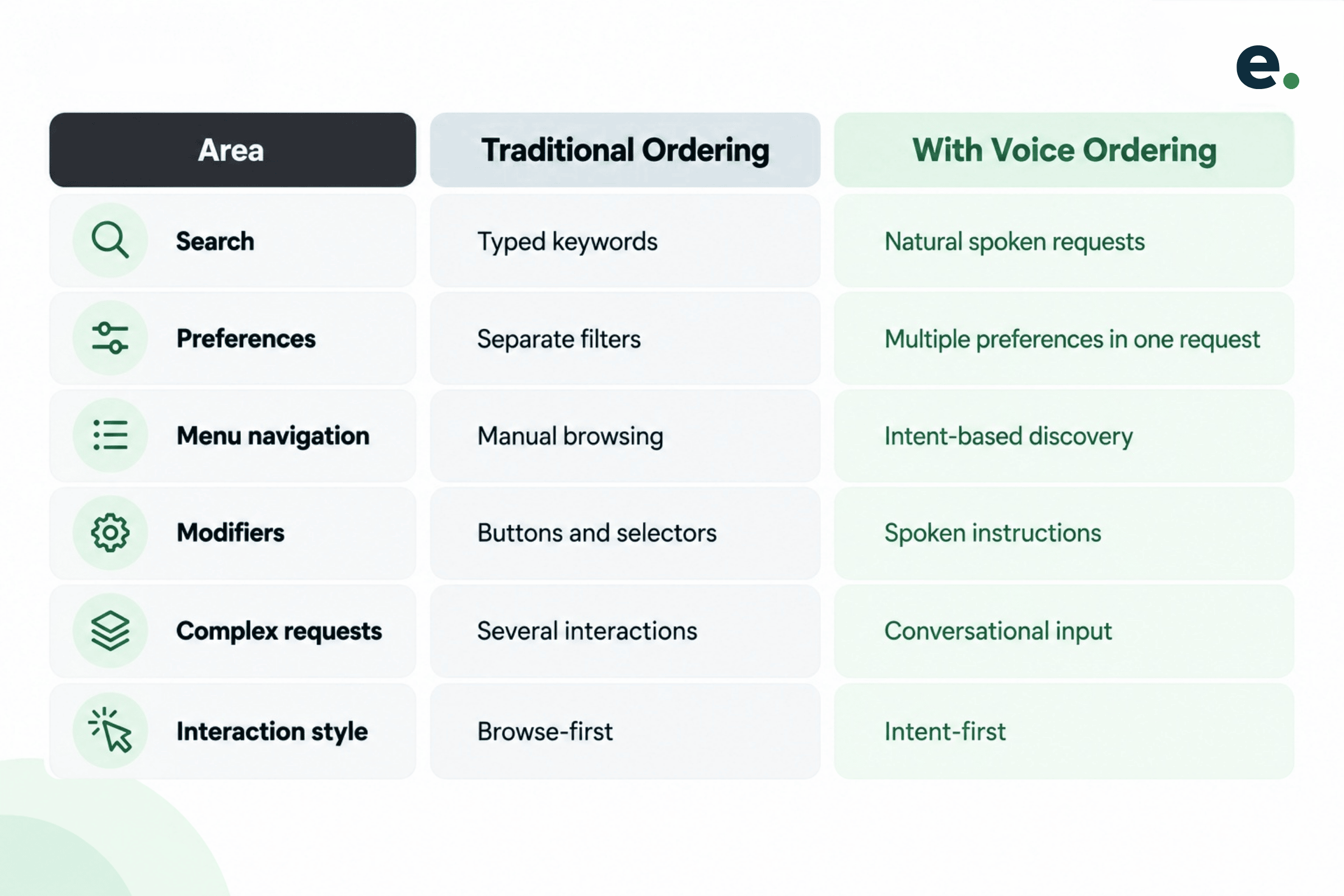
Voice Ordering vs Traditional Ordering Methods
Traditional browsing remains useful when customers want to explore visually. Voice becomes especially helpful when customers already have a clear intent and want to reach relevant choices faster.
What Voice Ordering Means for Restaurants and Food Delivery Platforms
The business value of voice ordering goes beyond making the customer journey slightly faster. When implemented well, it can improve how users discover food, interact with the platform, and move toward checkout.
For Customers
Voice can make ordering feel more direct and flexible.
- Less friction: Customers can describe what they want instead of navigating several menus, filters, and search fields.
- Better menu discovery: They can find suitable dishes even when they do not know the exact menu name.
- More convenient interaction: Voice gives customers another way to order alongside typing, tapping, and browsing.
- Improved accessibility: Some users may find speaking easier than navigating a complex interface or entering detailed requests manually.
For Restaurants and Platform Operators
The same capabilities can create broader value for the business.
- A more differentiated ordering experience: Conversational ordering can help a restaurant app or food delivery platform feel more intelligent than a standard menu-first interface.
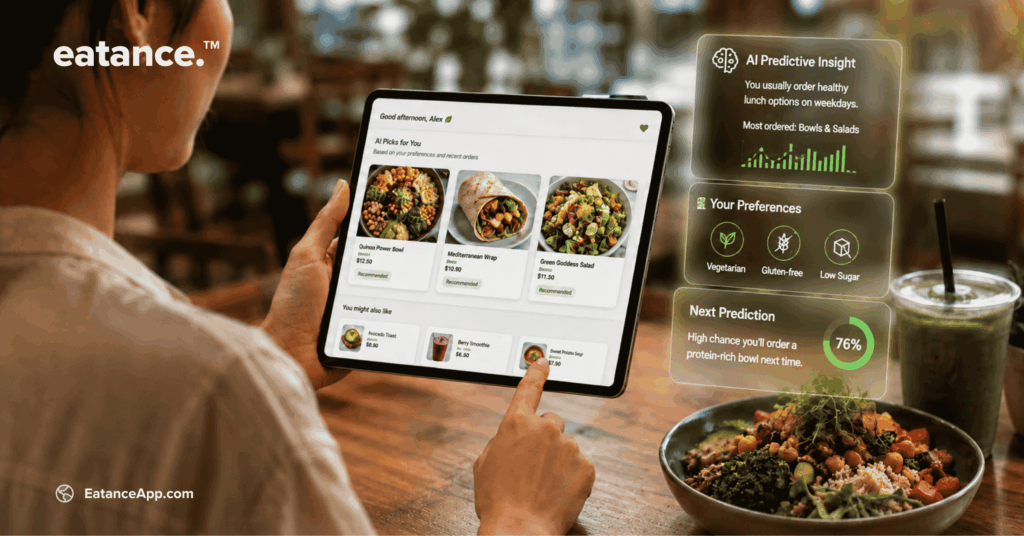
- Stronger personalization potential: Voice can become more useful when combined with customer preferences, recommendations, nutrition information, and ordering behavior.
- More effective discovery across larger menus: On multi-restaurant platforms, voice can help narrow a large number of choices into more relevant options.
- A more flexible digital experience: Businesses can offer voice as an additional interaction layer without removing the familiar visual ordering journey.
The value is therefore not just in replacing taps with speech. It is in giving customers a faster and more natural way to express intent, while giving restaurants and food delivery platforms more opportunities to improve discovery, personalization, and the overall ordering experience.
Challenges AI Voice Ordering Still Needs to Handle
Voice ordering is promising, but real-world conversations can still be difficult for AI to interpret accurately.
- Accents and speaking styles: Different pronunciations, speeds, and accents can affect recognition.
- Background noise: Busy restaurants, streets, and cars can make requests harder to capture.
- Complex food names: Regional, branded, or multilingual dish names may be difficult to understand.
- Detailed modifiers: Multiple instructions, such as size changes, add-ons, and exclusions, must be applied correctly.
- Multilingual ordering: Systems may need to understand different languages and local food terms.
- Real-time menu data: Voice AI needs current information on availability, prices, and modifiers.
- Order confirmation: Customers should be able to review the interpreted order before payment.
- Fallback options: Users should be able to switch easily to the standard app or website if voice fails.
A reliable voice ordering experience depends on accurate speech understanding, updated menu data, and a clear fallback path.
How Eatance MRP 3.0 Brings AI Voice Ordering Into the Customer Experience
Eatance MRP 3.0 brings AI Voice Ordering directly into the customer app, allowing users to describe what they want instead of relying only on menus, search, and filters.
For example, customers can say:
- “I want something vegetarian and spicy.”
- “Show me a light, high-protein meal.”
- “Find me a veggie pasta under $20.”
AI interprets the request and helps surface relevant menu options across the platform.
Voice Ordering is part of a wider AI experience in Eatance MRP 3.0 that also includes Food Scan, Smart Order & Diet, Smart Nutritional Composition, Compare & Decide, and Predictive Ordering.
For businesses building a white label food delivery app or white label restaurant app, this means voice and other AI capabilities can become part of their own branded ordering experience.
Rather than working as a standalone restaurant voice assistant, Voice Ordering becomes part of a broader AI restaurant ordering system that connects food discovery, ordering, and multi-restaurant operations in one ecosystem.
Bottom Line
AI voice ordering is about more than replacing taps with spoken commands.
Its bigger opportunity is helping restaurant platforms understand what customers actually want and reducing the effort required to find it.
With voice ordering for restaurants, customers can communicate their intent directly instead of always navigating categories, searches, filters, and restaurant menus first.
AI can then help interpret that request, connect it with menu and restaurant information, narrow the available choices, and create a more direct path toward checkout.
The opportunity becomes even greater on multi-restaurant platforms because customers are navigating more restaurants, more dishes, and more decisions.
As platforms such as Eatance combine Voice Ordering with food recognition, recommendations, nutrition intelligence, dish comparison, and predictive ordering, digital food ordering can gradually become more intent-driven.
That can make the overall experience faster, simpler, and closer to the way customers naturally think about what they want to eat.