![Multi Restaurant Aggregator [MRP]](https://eatanceapp.com/wp-content/uploads/2022/03/Hamburger.svg)



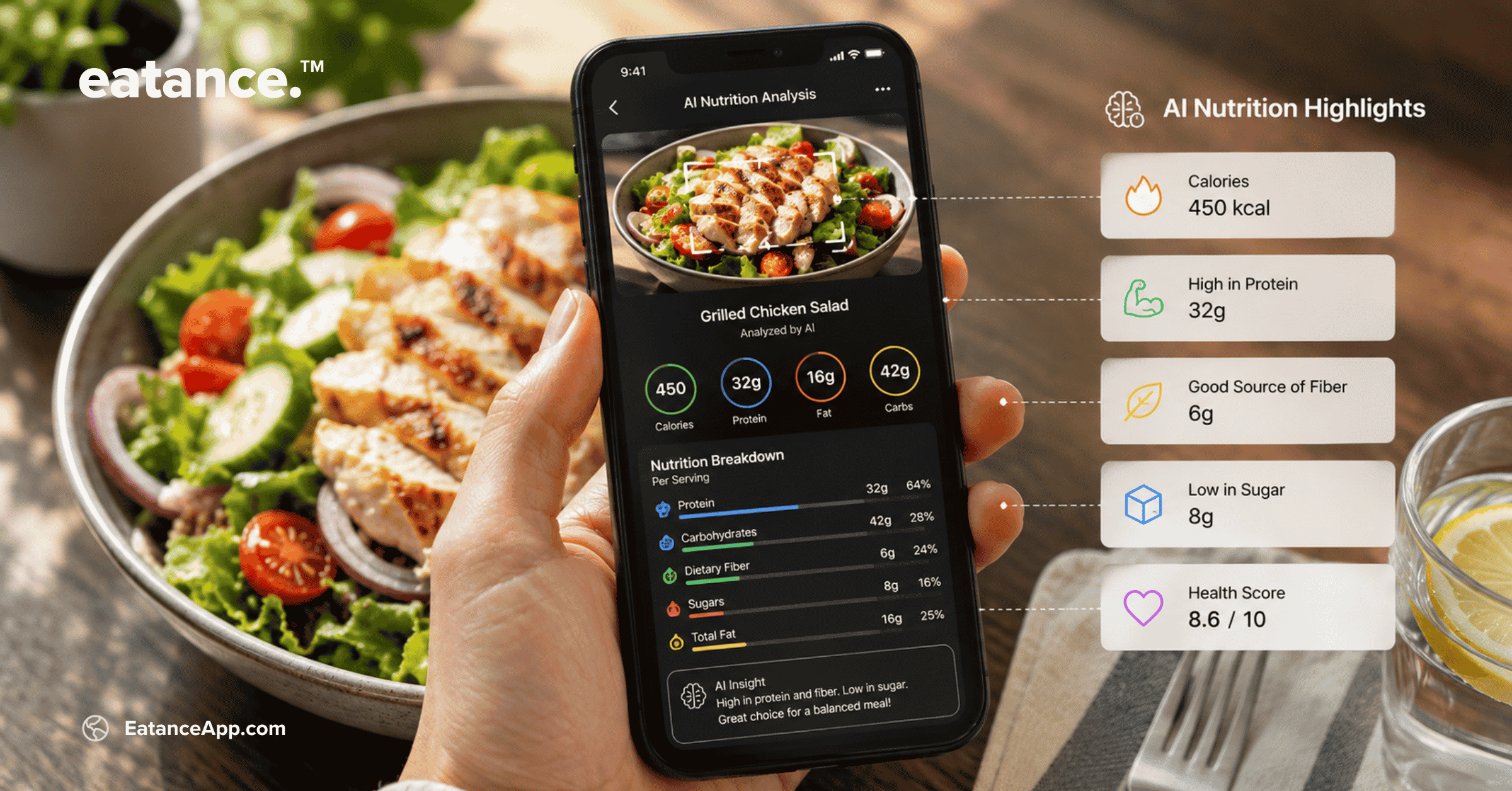
Think about the last time you ordered food online. Comparing restaurants, prices, ratings, and delivery times probably took seconds. But finding out what was actually in your meal may not have been as easy.
Calories, protein, carbohydrates, fats, sodium, and other nutritional details are often harder to access for restaurant dishes, where ingredients, portions, and preparation methods can vary.
This is where AI nutrition analysis is creating new possibilities. By combining AI with food databases, menu data, and image recognition, it can make nutritional information easier to access and understand.
In this blog, we explore how AI nutrition analysis works, what it can reveal about food, its role in restaurant ordering, its limitations, and how Eatance MRP 3.0 brings this capability into the ordering experience.
What Is AI Nutrition Analysis?
AI nutrition analysis uses artificial intelligence to interpret food-related data and turn it into useful nutritional insights. Depending on the system, it may analyze food images, dish names, menu descriptions, ingredients, recipes, portion sizes, or structured nutrition databases.
Using this information, AI can estimate values such as calories, protein, carbohydrates, fats, fiber, sodium, sugar, and other nutrients. In simpler applications, it may work like an AI nutrition calculator, where users provide details about a meal and receive an estimated breakdown. More advanced systems can integrate the same capability directly into food discovery, wellness, restaurant, or ordering platforms.
The real value is not just automating a nutrition label. It is making nutritional information easier to access when people are actually choosing what to eat.
Quick Stat:
In an analysis of more than 24,000 menu items across 257 restaurant chains, researchers found that calories alone were only weakly associated with overall nutrient density, reinforcing the need for broader nutritional context.
AI Nutrition Analysis vs. Traditional Nutrition Calculation
Traditional nutrition analysis usually depends on manually entering ingredients, quantities, serving sizes, and preparation details into a nutrition database. This can work well when exact recipe information is available, but it becomes difficult to manage across large menus or multi-restaurant platforms.
AI-assisted analysis can reduce that manual effort by interpreting available food information at a much larger scale. Instead of relying entirely on manual entry, it can process images, text, menu data, and other inputs to generate nutritional estimates more efficiently.
However, AI-generated values are still estimates when exact ingredient quantities, portions, or preparation methods are not available. For that reason, the quality of the input data remains just as important as the AI itself.
Quick Stat:
A systematic review found that reported calorie-estimation errors across AI food-image systems ranged from 0.10% to 38.3%, showing both the potential of the technology and the importance of input quality and validation.
Why Is Nutrition Information Still Difficult to Access?
Packaged foods usually follow standardized recipes, serving sizes, and labels. Restaurant meals are more variable, with nutrition changing based on ingredients, portions, cooking methods, sauces, and preparation styles.
This makes AI food nutrition analysis more complex, especially when the same dish can have different nutritional profiles across restaurants.
Manual Analysis Is Hard to Scale
Maintaining nutrition data across large menus takes time and frequent updates. For a multi restaurant online ordering system, managing hundreds or thousands of dishes across locations can become difficult as recipes and portions change.
Nutrition Data Often Sits Outside Ordering
Customers may need to leave the ordering app to search for nutrition information elsewhere, and even then, the data may not match the restaurant’s actual recipe.
AI can help bring useful nutritional context closer to the point where customers are deciding what to order.
How Does AI Nutrition Analysis Work?
Different platforms may use different technologies, but AI nutrition analysis generally follows a similar process, moving from identifying the food to generating an easy-to-understand nutritional breakdown.
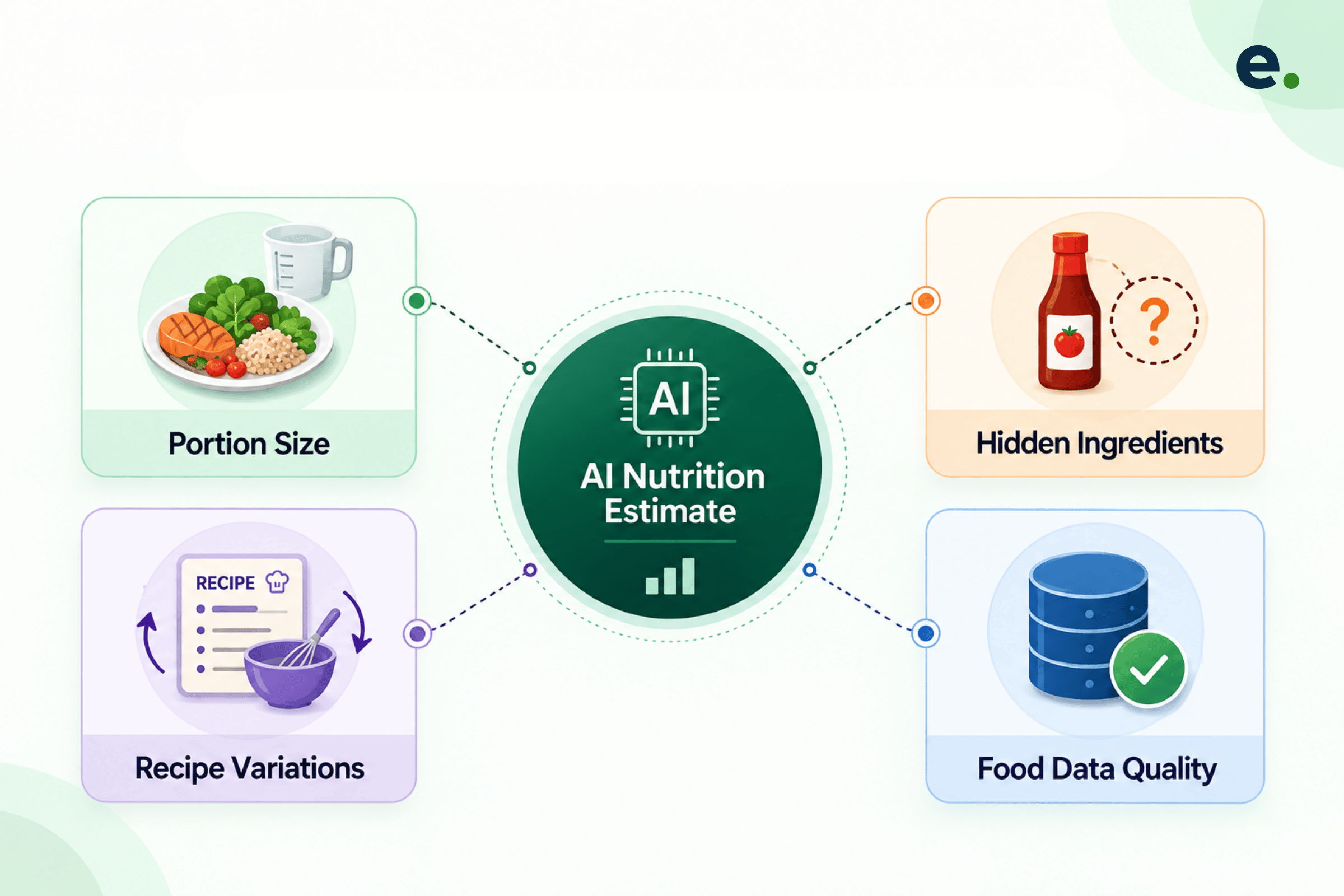
Key Factors Behind Accurate AI Nutrition Analysis
1. Identify the Food
The system first determines what is being analyzed using inputs such as a food image, dish name, menu description, ingredient list, recipe data, text, or voice. Computer vision can recognize visible foods, while natural language processing helps interpret written information.
2. Understand the Ingredients
Next, AI looks at what the dish may contain. Identifying a meal simply as a "salad," for example, is not enough. Ingredients such as vegetables, grains, cheese, dressings, or nuts can significantly change its nutritional profile.
3. Estimate the Portion
Serving size directly affects calories and nutrient values. AI may use visual cues, known serving sizes, restaurant data, or user input to estimate quantity. This can be challenging when the exact weight or volume of a meal is unknown.
4. Match It With Nutrition Data
The identified food, ingredients, and portion information are then matched with structured food databases. Reliable reference data is essential because useful AI nutrition information depends not only on recognizing the dish but also on accurately mapping it to its nutritional composition.
5. Generate the Nutrition Breakdown
Finally, the system converts the available data into a simple nutritional summary. Depending on the platform, this may include:
Calories | Protein | Carbohydrates | Fat | Fiber | Sugar | Sodium
Instead of researching individual ingredients manually, users receive a clearer snapshot of a meal's estimated nutritional composition.
What Can AI Nutrition Analysis Tell You About Food?
The most common use of an AI nutrition calculator is estimating calories, but AI can provide a much broader nutritional picture of a meal. Depending on the data available, it can surface information across several categories.
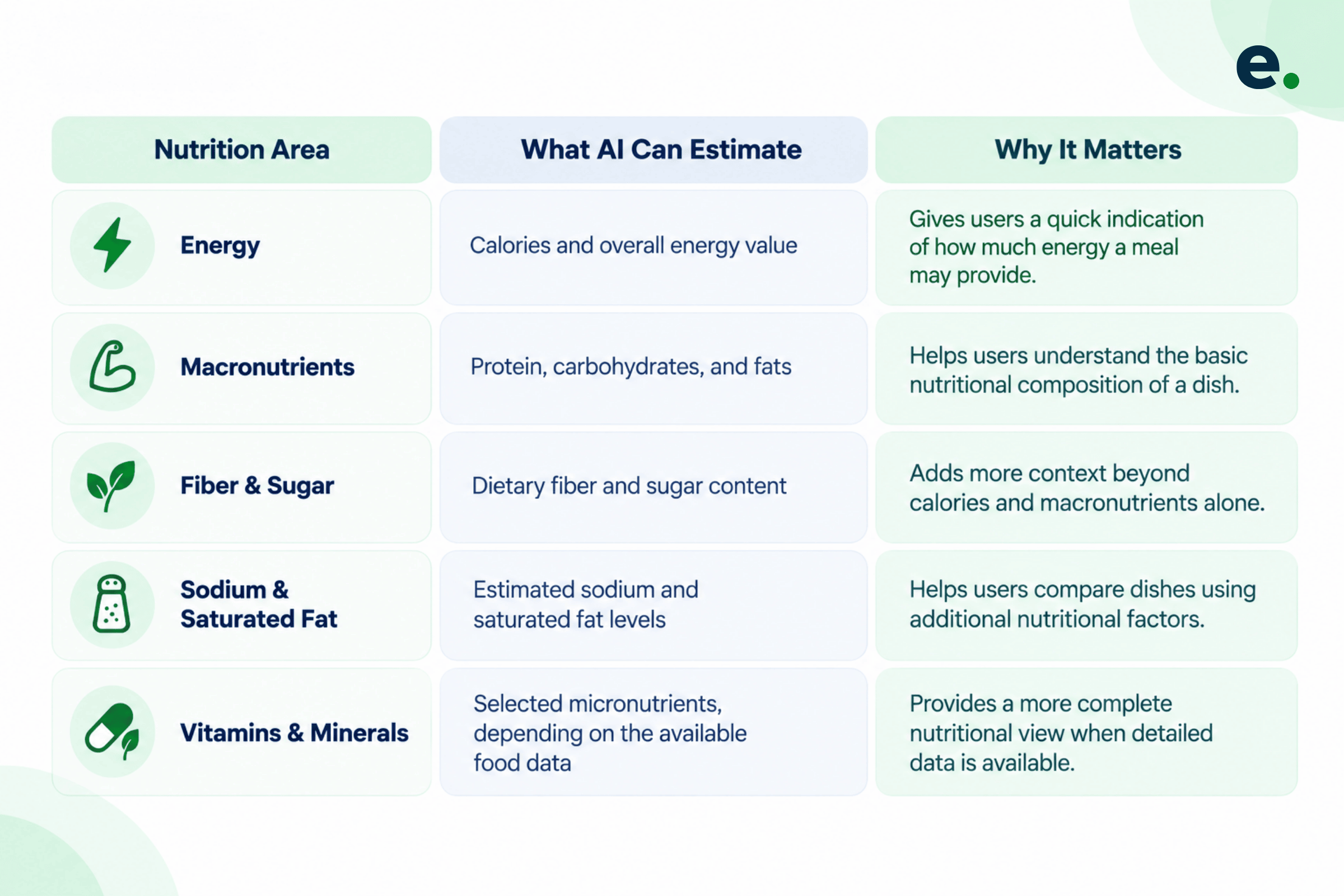
Key Nutrition Metrics AI Can Estimate
Research published in PLOS One found that participants wanted access to additional nutritional information on restaurant menus, including details such as sugar, fat, protein, carbohydrates, and salt.
Chart Placement
A calorie count alone does not tell the full story. Two meals may contain a similar number of calories while differing considerably in protein, fiber, sodium, sugar, or fat. This is why broader AI nutrition information can be more useful than a single number.
However, not every system provides the same level of detail. The quality and depth of the nutritional breakdown depend on factors such as ingredient data, portion size, preparation method, recipe information, and the nutrition database being used.
How AI Makes Nutrition Information More Accessible
The value of AI nutrition analysis is not only in generating nutritional data. It is in making that information easier to access, understand, and use while customers are deciding what to order.
Quick Stat:
In a 2026 randomized restaurant study involving 2,462 diners, 87% said nutrition labels were understandable and 63% said the labels influenced their food choices,
Nutrition at the Point of Decision
Instead of searching for nutrition details after choosing a meal, customers can access them during food discovery. Nutritional insights can appear alongside the dish name, ingredients, price, and restaurant information, making them part of the normal ordering journey.
Easier Comparison Between Dishes
AI can add another layer to food comparison. Along with price, ratings, and delivery time, customers may also compare factors such as calories, protein, ingredients, and other nutritional values.
This gives users more context without telling them what they should or should not eat.
Simpler, More Understandable Information
Nutrition data can quickly become technical or overwhelming. AI-powered interfaces can organize that information into clearer summaries, making it easier for everyday users to understand without needing specialist knowledge.
Greater Coverage Across Large Menus
This becomes especially useful for restaurant chains and food marketplaces. A multi restaurant app may contain hundreds or thousands of menu items, making manual nutrition entry difficult to maintain.
AI-assisted analysis can help extend nutritional visibility across more dishes while reducing the amount of manual work required.
How AI Nutrition Analysis Can Improve Restaurant Ordering
Infographic 2:
More Informed Discovery
Customers can use nutrition details alongside taste, price, and preferences to narrow down suitable meals.
Better Menu Transparency
Adding nutritional context gives users a clearer understanding of a dish before ordering.
Quick Stat:
A large-scale study across 2,329 restaurants found that menu calorie labeling was associated with about 24.7 fewer calories purchased per transaction over the following 3 to 24 months
More Personalization
When combined with dietary preferences, past orders, and ingredient choices, nutrition data can support more relevant food recommendations.
AI Nutrition Analysis Is About More Than Counting Calories
AI nutrition is often associated with calorie tracking, but its broader value is helping people understand and evaluate food more easily.
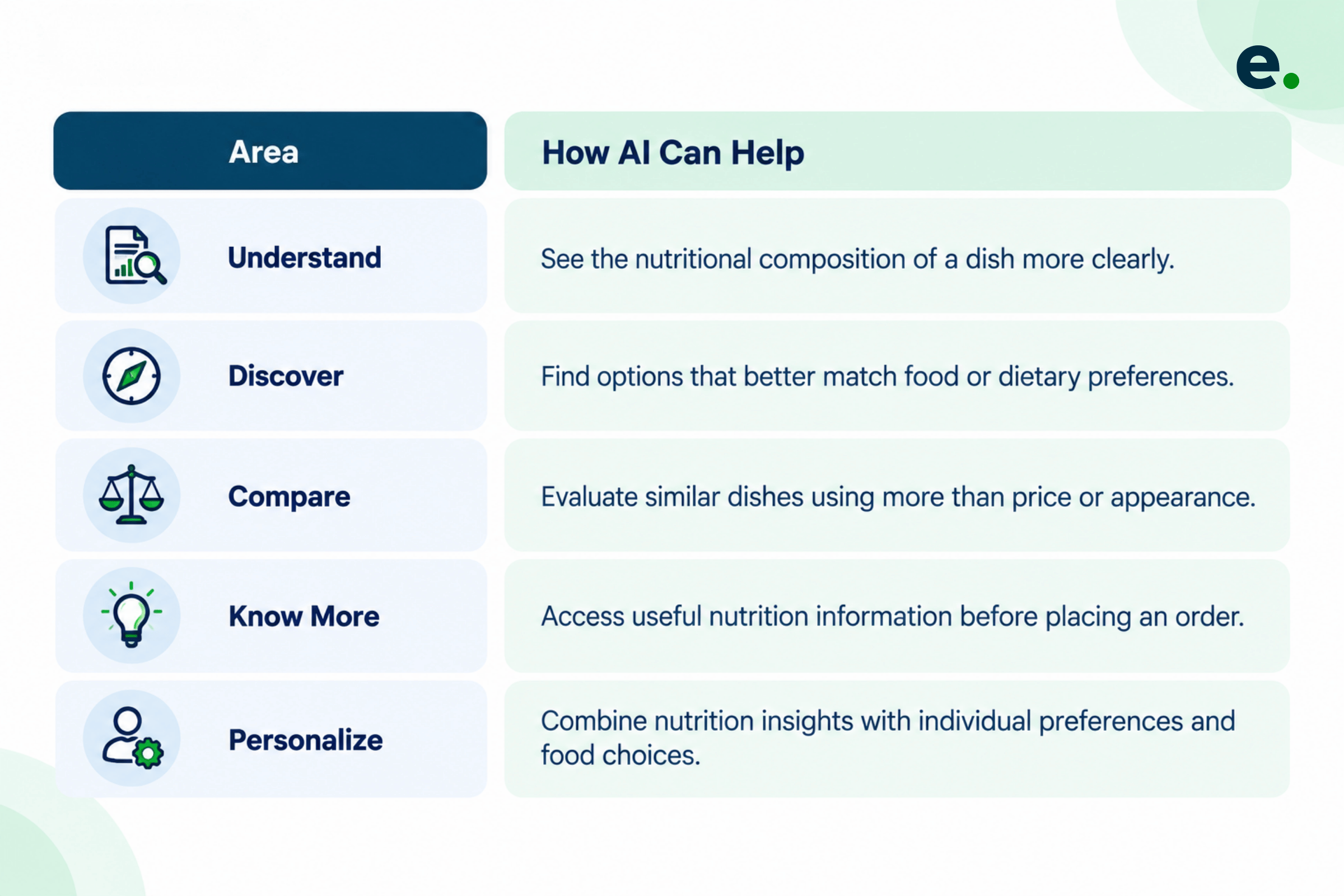
AI Nutrition Analysis for Deeper Food and Nutrient Insights
This shifts food nutrition technology from simply recording what someone has already eaten toward helping customers understand, compare, and choose food before they order.
Where Can AI Nutrition Analysis Be Used?
AI-powered nutrition analysis can support several parts of the food ecosystem:
- Nutrition & Wellness Apps: Simplifies meal logging by turning food images or descriptions into estimated nutrition data.
- Restaurant Ordering Platforms: Adds nutritional insights directly to digital menus and ordering journeys.
- Multi-Restaurant Marketplaces: Helps a multi restaurant online ordering system provide nutrition information across many restaurants and menu items.
- Institutional Food Services: Supports cafeterias, universities, hospitality, and catering environments with clearer food information.
- Healthcare & Wellness: Can assist with nutrition tracking and dietary awareness, while professional guidance remains important for clinical decisions.
What Are the Limitations of AI Nutrition Analysis?
AI can make nutrition information more accessible, but its accuracy still depends on the quality of the available data.
Infographic 3:
Food & Portion Variability
Serving sizes, hidden ingredients, sauces, oils, and restaurant-specific recipes can all change a dish’s actual nutritional value.
Recognition & Data Gaps
Regional dishes, uncommon ingredients, and limited food database coverage can make some foods harder for AI to identify accurately.
Estimates, Not Exact Measurements
Unless exact ingredient quantities and verified recipe data are available, AI-generated nutrition values should be treated as informed estimates rather than precise measurements.
For this reason, platforms should clearly communicate when nutritional information is AI-generated or estimated.
What Makes AI Nutrition Analysis More Useful?
AI nutrition analysis becomes more useful when the system has better inputs and clearer ways to present the results.
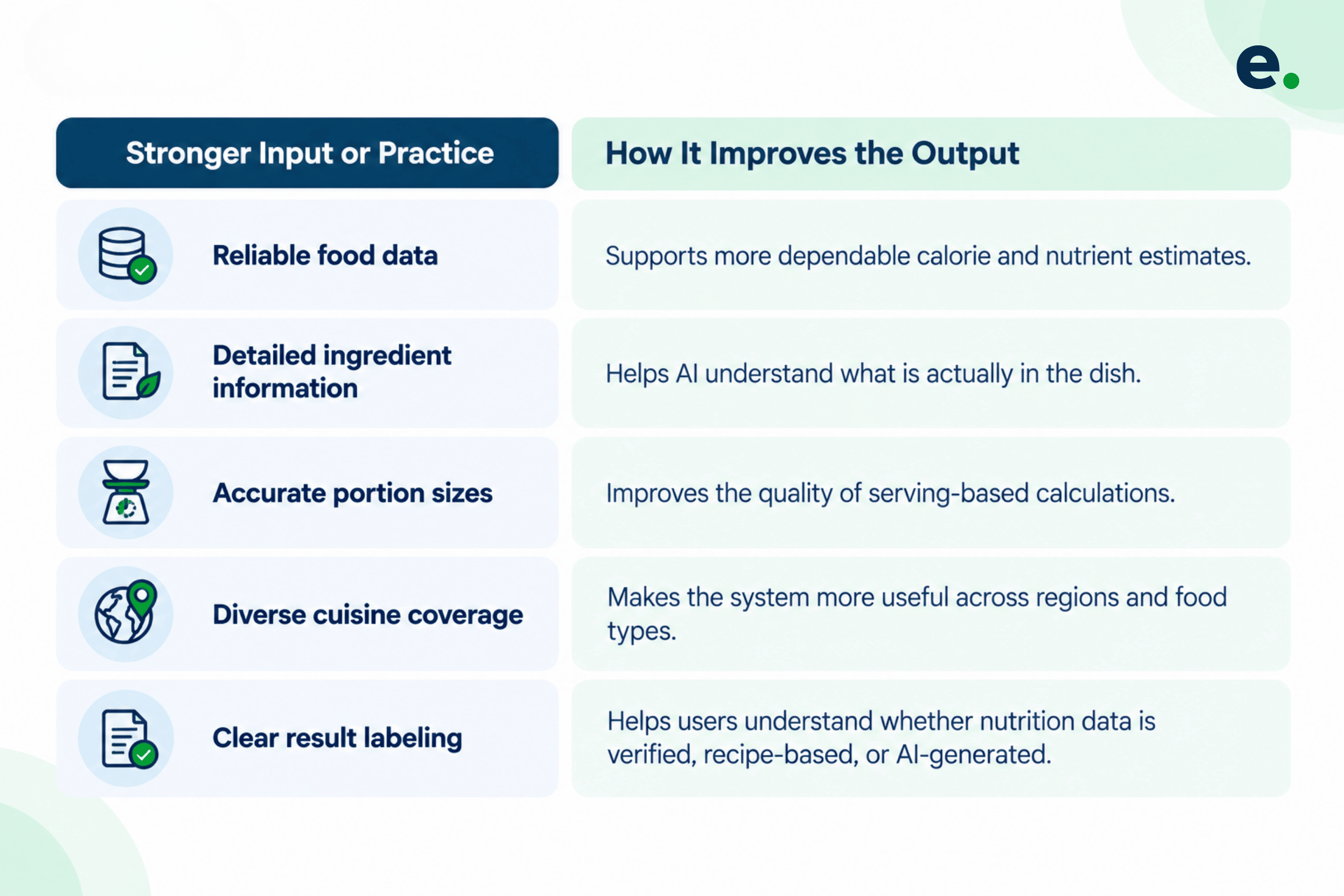
What Improves the Accuracy of AI Nutrition Results
The basic principle is simple:
Reliable Data + Better Context + Clear Communication = More Useful Nutrition Insights
AI can process information quickly, but the quality of the final result still depends heavily on what the system has to work with.
AI Nutrition Analysis in Eatance MRP 3.0
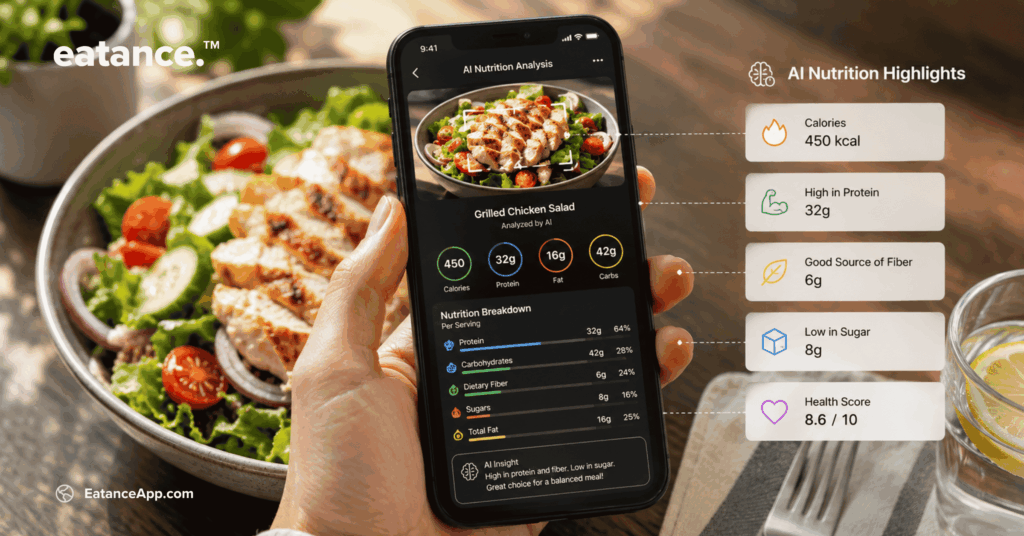
Eatance MRP 3.0 brings AI-powered nutrition directly into the customer ordering experience through its Smart Nutritional Composition feature.
The feature automatically generates a nutritional breakdown for dishes without requiring restaurants to manually enter nutrition data for every menu item. This helps customers access additional food information while they are already browsing and comparing dishes inside the app.
For businesses managing large multi-restaurant menus, this can make nutrition information easier to scale across multiple restaurants and locations.
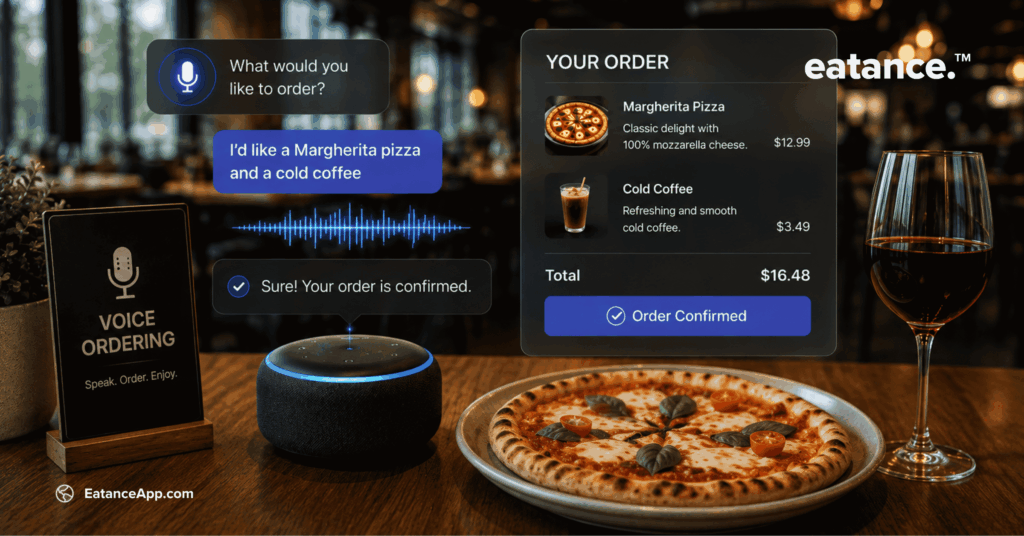
Smart Nutritional Composition is part of MRP 3.0’s broader AI layer, which also includes Food Scan, Smart Order & Diet, Compare & Decide, Predictive Ordering, and Voice Ordering.
For operators building a white-label food delivery app it shows how nutrition insights can become a built-in part of the ordering journey rather than a separate add-on.
Bottom Line
AI nutrition analysis is moving beyond simple calorie estimation to make food information easier to access, understand, and use during everyday decisions.
Its value is especially clear in digital ordering, where nutritional context can support food discovery, comparison, and personalization. However, accuracy still depends on factors such as portion size, ingredients, recipe data, and the quality of the underlying food information.
As the technology improves, platforms like Eatance MRP 3.0 show how AI-powered nutrition can become a natural part of the restaurant ordering experience, helping customers not only find food faster, but understand it better.