![Multi Restaurant Aggregator [MRP]](https://eatanceapp.com/wp-content/uploads/2022/03/Hamburger.svg)



Ordering food online is supposed to save time. But when customers are faced with endless restaurant lists, long menus, repeated filters, and dozens of similar dishes, choosing what to eat can quickly become the hardest part of the experience.
That is where AI food recommendations can make a real difference.
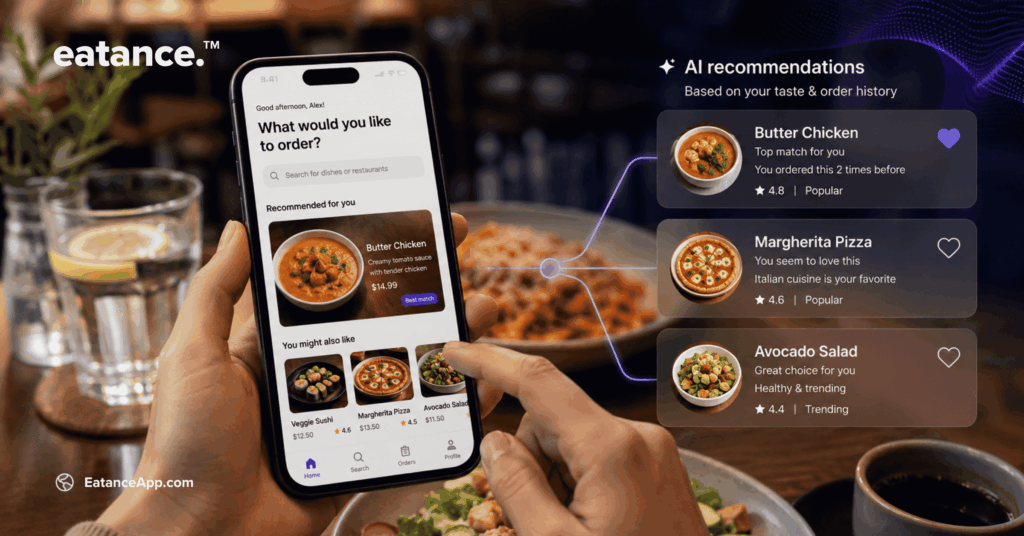
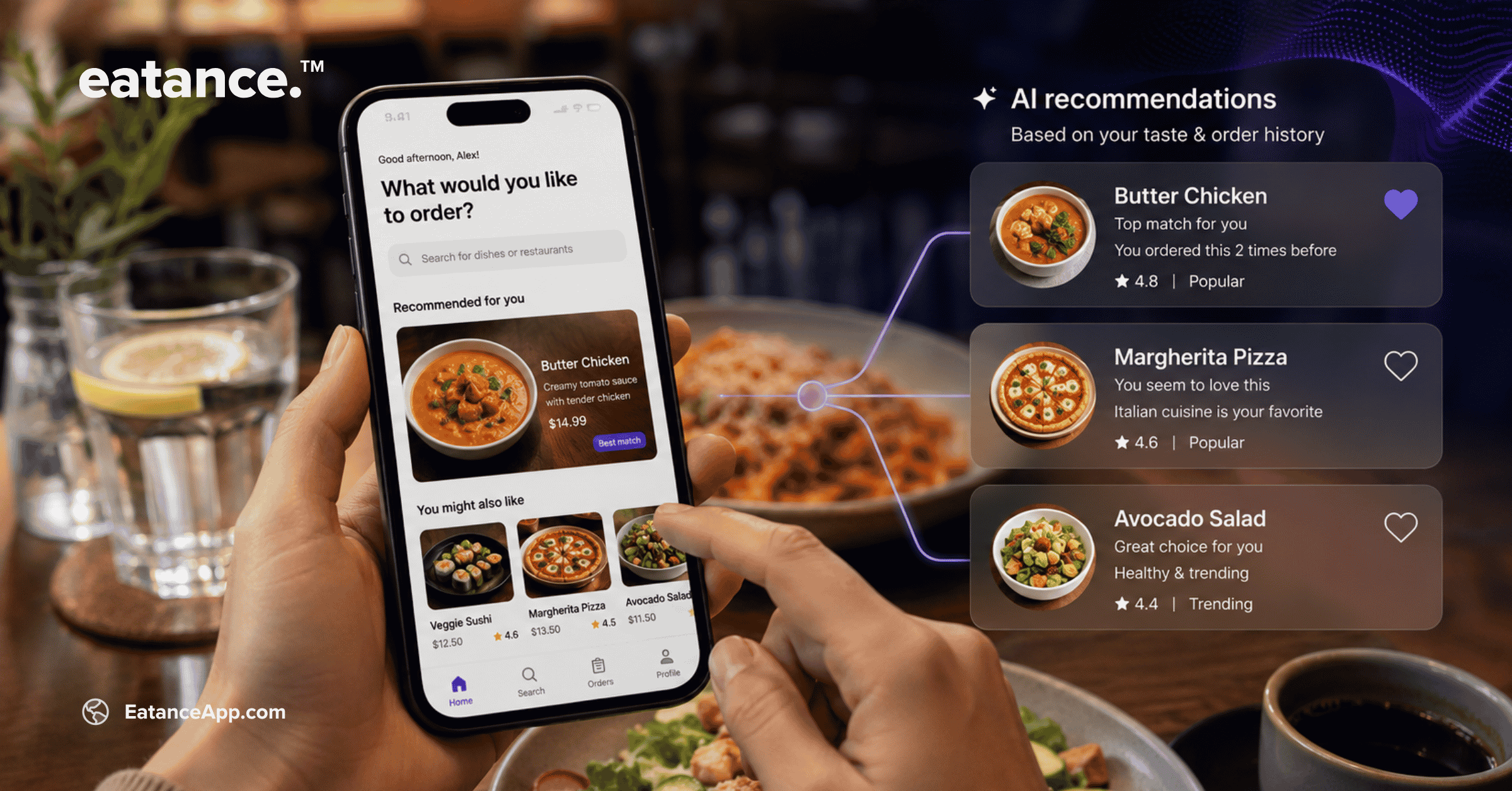
Instead of asking customers to search through every available option, AI can interpret signals such as cravings, dietary preferences, past orders, browsing behavior, cuisine interests, and time of day to surface dishes that are more relevant to the moment.
The result is a more focused ordering journey with less scrolling, fewer unnecessary choices, and a faster path from discovery to decision.
For restaurants and food delivery platforms, this also creates an opportunity to make ordering more personalized and intuitive. In this blog, we explore how AI-powered recommendations work, where they add value, why they become even more useful on multi-restaurant platforms, and how Eatance MRP 3.0 brings these capabilities into the customer ordering experience.
What Are AI-Powered Food Recommendations?
AI-powered food recommendations use artificial intelligence to suggest dishes that better match a customer’s preferences, behavior, and current intent.
Traditional restaurant menus usually show the same categories and popular items to everyone. A more advanced food recommendation system can go further by considering signals such as previous orders, dietary preferences, preferred cuisines, browsing activity, time of day, and current cravings.
For example, a customer might search:
Something spicy, vegetarian, and not too heavy for dinner.
Instead of manually opening multiple menus, applying filters, and comparing dishes, AI can interpret that request and surface options that are more relevant.
In simple terms, the experience shifts from merely displaying available food to actively helping customers discover what they are most likely to want.
Quick Stat:
According to McKinsey, 71% of consumers expect personalized interactions, and 76% get frustrated when they do not receive them.
Why Traditional Restaurant Ordering Can Create Decision Fatigue
More choice can be useful, but it can also make ordering feel harder than it should.
A typical food ordering app may include hundreds of dishes across different restaurants, along with cuisine categories, dietary filters, price ranges, offers, and customizations. The more options customers have to sort through, the more effort it can take to find the right meal.
How AI-Powered Food Discovery Improves Restaurant Ordering
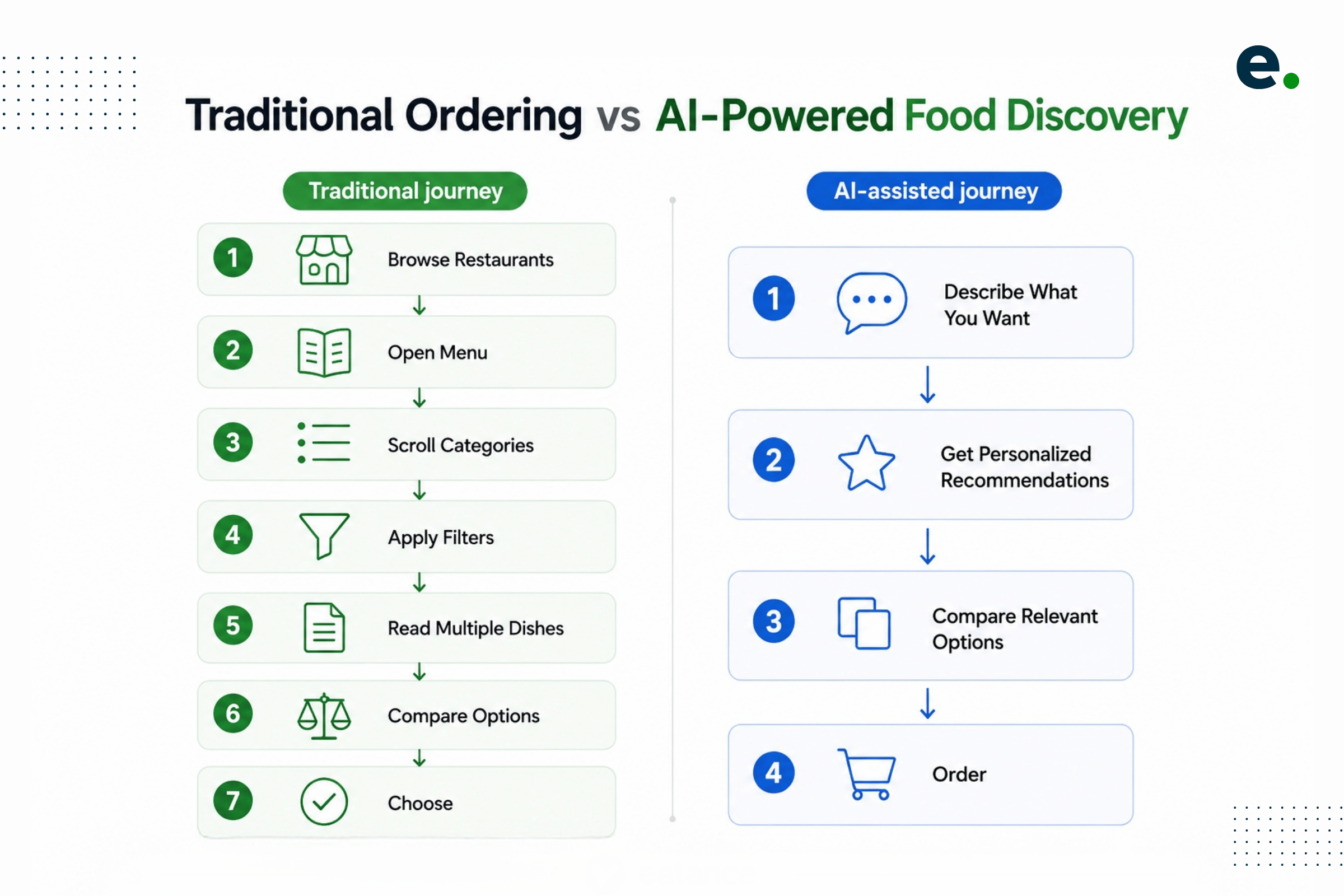
For example, someone looking for a high-protein vegetarian dinner may need to:
- Browse multiple restaurants
- Open individual menus
- Search for vegetarian options
- Read dish descriptions and ingredients
- Compare prices and alternatives
- Repeat the process if nothing feels right
For a routine meal decision, that is a lot of searching.
This is where AI menu recommendations can make the experience easier. Instead of asking customers to narrow a large catalog manually, AI can surface a smaller set of more relevant dishes based on what they are actually looking for.
The goal is not to reduce choice. It is to make choice easier to navigate.
“We always find consumers like to have curation or suggestions, such as ‘you might like this,’ as opposed to a literal menu of ‘here’s every possible option and permutation.’”
- John Moran, Partner, McKinsey & Company
How AI Improves Food Discovery During the Ordering Journey
The real value of AI in restaurant ordering is not just automation. It is helping customers find relevant food faster and with less effort.
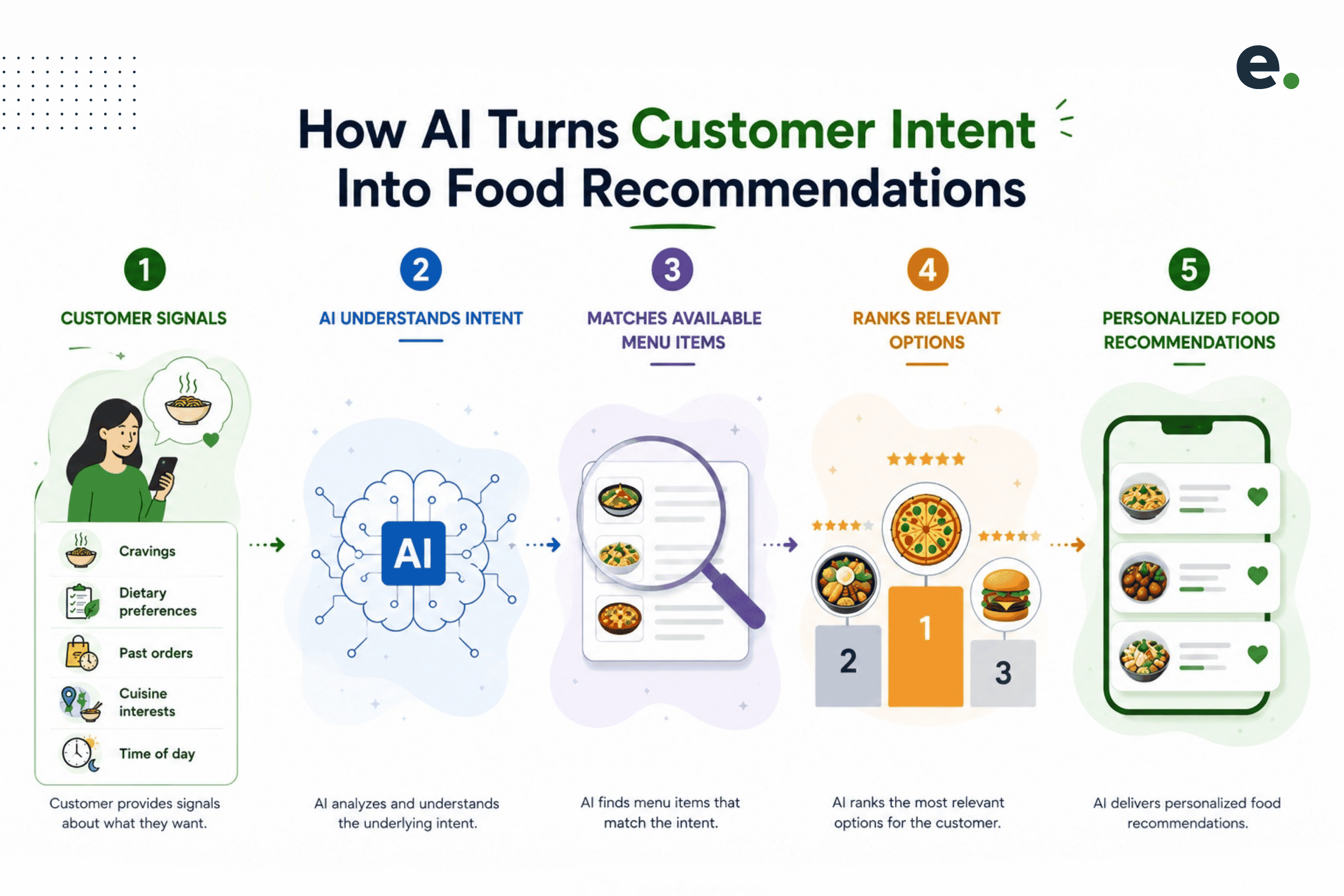
AI-Powered Food Recommendation Process for Restaurants
AI Understands Customer Intent
Traditional search works best when customers already know what they want. But food choices are often more specific than a single keyword.
A customer may be looking for something light, spicy, vegetarian, high in protein, or within a certain budget. AI restaurant recommendations can interpret these natural-language requests and understand the intent behind them.
For example, a search like “something vegetarian, spicy, and suitable for dinner” can be matched with dishes that fit those preferences more closely.
AI Matches Preferences With Relevant Dishes
Once the intent is understood, AI can connect it with suitable menu items.
It may consider factors such as cuisine, ingredients, dietary preferences, meal type, flavor profile, and previous food choices to identify more relevant options.
This makes recommendations more useful than generic sections such as “Popular Near You,” because the suggestions are based on individual preferences rather than overall popularity.
AI Narrows Down the Choices
Large restaurant platforms can offer hundreds of restaurants and thousands of menu items, which can make discovery more difficult.
On a multi restaurant app, AI can narrow that large catalog into a smaller set of relevant options based on what the customer is looking for.
The customer still chooses the final dish, but spends less time scrolling, filtering, and comparing.
AI Makes Repeat Ordering Easier
Many customers develop familiar ordering patterns over time.
They may return to the same cuisines, restaurants, dishes, or meal types at similar times. AI can use these patterns to surface relevant options earlier in future visits.
This can make personalized restaurant ordering more convenient, especially for returning customers who do not want to start their search from scratch every time.
What Customers Gain From AI Food Recommendations
The customer benefits of AI recommendations are practical rather than abstract.
Faster Food Discovery
Customers can move more quickly from browsing to relevant dishes without repeatedly opening menus.
More Relevant Options
Instead of seeing the same recommendations as everyone else, users can receive suggestions based on their own preferences and intent.
Easier Dietary Discovery
Customers with specific dietary preferences may be able to identify suitable dishes more efficiently.
Less Decision Fatigue
A smaller, more relevant set of choices is easier to evaluate than a large catalog.
More Convenient Repeat Ordering
Previous preferences and ordering habits can make future visits more efficient.
Together, these improvements can make restaurant ordering feel less like searching a database and more like interacting with a digital food assistant.
How AI Recommendations Help Restaurants and Food Platforms
AI recommendations can help restaurants and food platforms improve discovery, make better use of their menu inventory, and simplify repeat ordering.
Improve Menu Item Visibility
Some dishes can get buried deep within a menu. AI can surface them when they are relevant to a customer’s preferences, giving restaurants another way to improve discovery beyond featured items or manual placement.
Connect Customer Intent With Restaurant Inventory
Customers may know what they want to eat without knowing which restaurant offers it. AI can match that intent with suitable dishes across available restaurants, creating a more direct path from craving to choice.
Support Repeat Ordering
AI can use previous orders and recurring preferences to surface familiar dishes or similar alternatives, helping returning customers find relevant options faster.
Quick Stat:
In Deloitte’s 2025 restaurant research, restaurant executives identified personalized offers at the point of order and ordering suggestions among the digital initiatives with the highest impact on performance.
Improve Discovery Across Larger Platforms
In a multi restaurant online ordering system, more restaurants also mean more choices to navigate. AI can organize that larger inventory around customer preferences, making relevant restaurants and dishes easier to find.
AI Recommendations vs Traditional Menu Filters
Traditional filters still play an important role in restaurant ordering. The difference is that filters require the customer to decide how to narrow the menu, while AI can help interpret intent and suggest relevant options automatically.
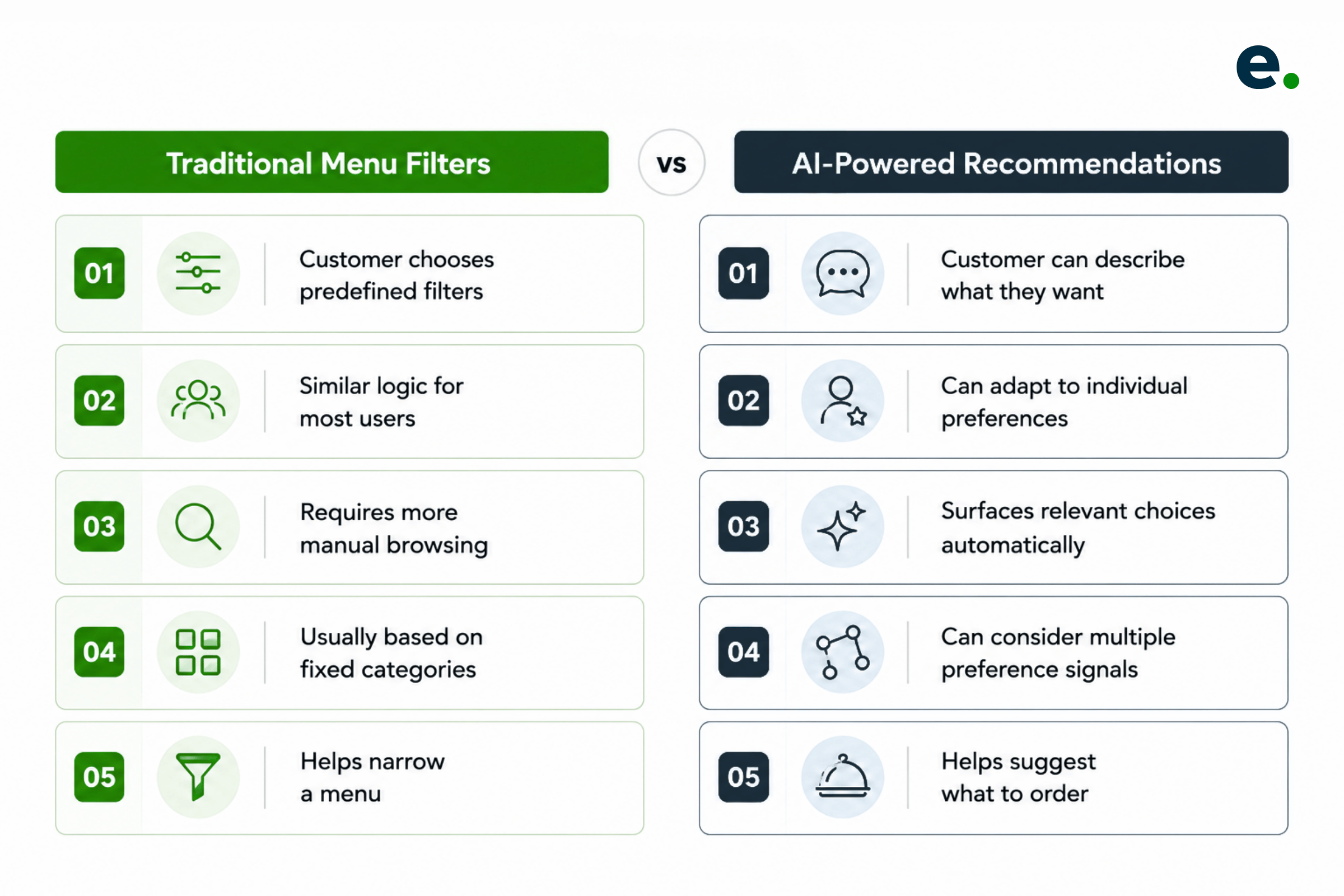
AI-Powered Recommendations vs Traditional Food Ordering Filters
The two approaches can work together. Filters provide control, while AI can make initial food discovery faster and more intuitive.
How Eatance MRP 3.0 Brings AI Recommendations Into Restaurant Ordering
Eatance MRP 3.0 brings AI directly into the customer ordering journey, helping users discover, compare, and reorder food with less effort.
Smart Order & Diet
Customers can describe what they are craving and add dietary preferences in their own words. AI then suggests dishes that better match the request.
Predictive Ordering
The app can learn from ordering habits and surface relevant dishes based on previous behavior and preferences, making repeat visits easier.
“Being able to anticipate what customers want, when they want it, will hopefully lead to better customer engagement with the brand.”
- Ashley Fenn, VP of Business Insights and Marketing at Flynn Group
Food Scan
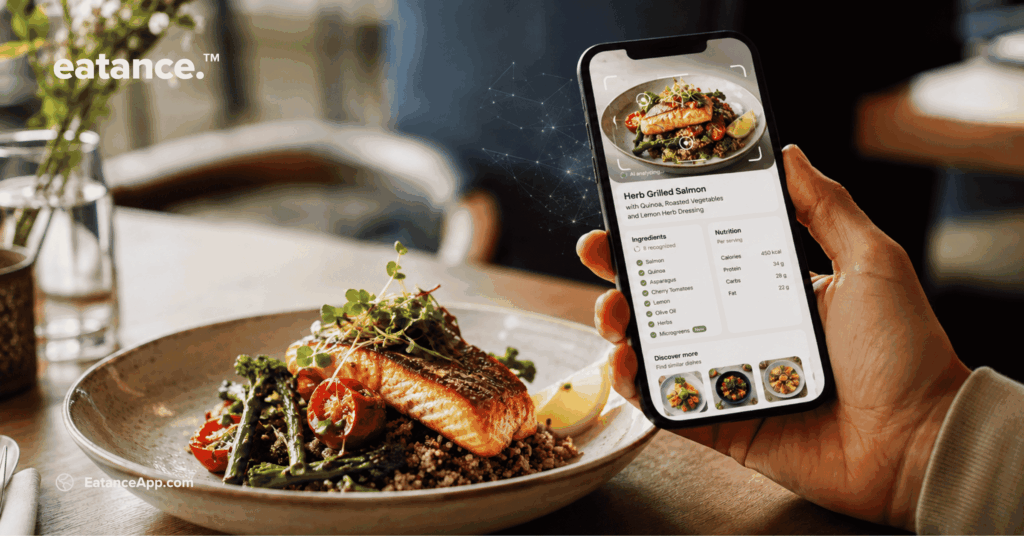
Customers can photograph a dish and search for it across restaurants on the platform, creating a visual way to discover food.
Compare & Decide
Customers can compare the same dish across different restaurants and receive an AI-assisted verdict to help narrow down the options.
Together, these features support a smarter journey from food discovery to decision-making and repeat ordering. For businesses exploring a white label food delivery app or white label restaurant app, this means AI-powered discovery can be built into their own branded customer experience.
Why AI Matters More on Multi-Restaurant Platforms
AI recommendations become more valuable as the number of restaurants and menu items grows.
In a single restaurant app, customers may only need to browse a few dozen dishes. In a multi restaurant app, they may be choosing from hundreds or even thousands of options across different cuisines, price points, dietary preferences, restaurant availability, and variations of the same dish.
That level of choice can be useful, but it can also make discovery harder. The more options a platform offers, the more effort customers may need to put into finding the one that actually fits what they want.
AI helps simplify that complexity by starting with customer intent.
Instead of asking, “Which restaurant should I open first?” the experience can begin with a much simpler question: “What do I feel like eating?”
From there, AI can identify relevant dishes across the wider restaurant network and narrow the available options into a more manageable set.
For operators building a multi restaurant online ordering system, this matters because the value of the platform is not only in how many restaurants it brings together. It is also in how easily customers can discover the right choice within that larger ecosystem.
Quick Stat:
According to the National Restaurant Association’s 2025 Off-Premises Restaurant Trends report, 37% of adults order restaurant delivery at least once a week, with usage even higher among younger consumers.
What to Consider When Using AI Food Recommendations
AI recommendations can improve discovery, but their usefulness depends on how well the system is implemented.
Recommendation and Menu Accuracy
AI can only work with the information available to it.
Incomplete dish descriptions, missing ingredients, inaccurate categories, or poor menu data can reduce recommendation quality. Restaurants should maintain clear and accurate menu information.
Dietary Transparency and Customer Control
Dietary recommendations require additional care. Customers should still be able to review ingredients, restaurant-provided information, and other relevant details before making a decision. AI should assist decision-making, not replace it. Users should also retain the ability to search manually, change preferences, or ignore recommendations.
Privacy and Recommendation Quality
Personalization may involve customer behavior and preference data. Platforms should handle this information responsibly and follow applicable privacy requirements.
Recommendation systems should also avoid becoming overly repetitive. Strong personalization should balance relevance with enough variety to support discovery.
Bottom Line
AI food recommendations are making restaurant ordering more useful by helping customers reach relevant choices faster, without taking away their control over the final decision.
For customers, that means less browsing and a more personalized experience. For restaurants and food platforms, it creates a smarter way to connect customer intent with the right dishes, especially within a multi restaurant online ordering system where choice can quickly become overwhelming.
Eatance MRP 3.0 brings this approach into practice through features such as Smart Order & Diet, Predictive Ordering, Food Scan, and Compare & Decide, helping make food discovery more intuitive across a multi-restaurant ecosystem.
The real opportunity is not to show customers more options. It is to help them find the right option with less effort.